Monday, February 05, 2007
This is an actual headline from the (Beirut) Daily Star: "USAID says its top priority is to create more jobs"

"Afghanistan remains the forgotten war and yet, in an eerie lockstep with Iraq, it seems to be following a distinctly Bush administration-style path toward "the gates of hell.""
A conservative tribute to the man who so grossly inflated the figures of Soviet victims. (His biography of Stalin was an interesting read, despite the serious political and methodological problems).
"A group of prominent Jewish artists, intellectuals and academics Monday launched a movement aimed at challenging the dominance of Britain's long-established main Jewish organization and opening debate over the conflict in the Middle East. The group, Independent Jewish Voices (IJV), announced its establishment in ads in The Times and the Jewish Chronicle, and in an article by Oxford philosopher Dr. Brian Klug, one of the group's founders, in the Guardian's "Comment Is Free" blog, entitled "Who Speaks for Jews in Britain?"
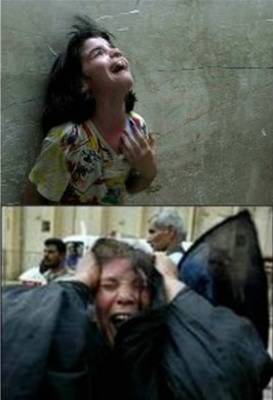
Do you notice that US media, and even US officials, speak less of "liberation" of Iraq? "Children of war: the generation traumatised by violence in Iraq"
For fans of the "Cedar Revolution": ""There is a reappearance of arms in the hands of almost every political group; we are sitting on a powder keg, tension is increasing every day," said a prominent security analyst. "They don't know what they are doing, they are going to destroy this country."...The sense of instability has deepened with the seizure of guns and training equipment in November from members of a former Christian militia commando unit as well as reports by US intelligence analysts of fighters loyal to Lebanon's largest Sunni party being trained abroad. The private intelligence company Stratfor reported in December that "Lebanon's Sunni bloc, led by the Hariri clan and their regional Arab allies, has sent a number of fighters to Jordan, Saudi Arabia and Egypt to receive military training to counter Hizbullah's well-equipped and well-trained military forces.""
For those who asked me, no, I am not taking part in the debate on the Israeli lobby in San Francisco, although an invitation has gone out with my name. I have sent my disagreement with the latest phrasing of the debate statement; I do think that the Israeli lobby is dominant. I never said otherwise. I just don't think that the Israeli lobby is the sole determinant of US foreign policy in the Middle East. I was willing to debate that thesis, as I told the organizers. My position on the lobby is here.
To throw the shoe, or not to throw the shoe: a cultural dilemma. Don't you love it when Western reporters explain to their readers differences between their culture and Arab culture? I don't know about you, but I really love it. Here is from the New York Times: "During the argument, heated words were exchanged and shoes were thrown, a severe insult in the Arab world." So throwing a shoe at somebody is a "severe insult in the Arab world" but not anywhere else? How exotic. Tell me more, o culture experts of the New York Times. So today, I wanted to test this theory. So I got out of my house with a bag of shoes: I started throwing them, shoe by shoe, at my neighbor, aiming at the face. My neighbor laughed, and could only say nice things to me as a good neighbor. He then explained: you see, o Arab neighbor, in our American culture, throwing a shoe at somebody is not an insult at all. In fact, it is taken as a sign of affection. I returned back to my house, having learned about American culture, what I knew not before. Thanks to you, New York Times (and your intelligent and culturally informed reporters).
"The impression that a bloodless battle has been won in Libya rests on an inflated notion of the threat the country, even with its rusty weapons of mass destruction, ever posed to the West. It misreads an act of diplomatic negligence toward the rights of the Libyan people as a victory for world peace. Colonel Qaddafi deserves sole credit for Libya’s foreign policy U-turn. He has never found it necessary to devote himself to a single political ideology; his only consistent policy has been to guard his personal political survival. The United States and Britain understand this, but have only exploited it for their own myopic objectives, forgetting that Libya’s political development can lie only with its people."
"Après avoir axé son sermon dominical sur la famille, condamnant autant l’homosexualité que l’avortement, lors de la messe qu’il a présidée à Bkerké, le patriarche Sfeir a observé que « ce qui se passe sur notre terre n’a rien de rassurant »." Taking time from his busy schedule of arranging his vast collection of hats, the Patriarch addresses the underlying causes of Lebanese conflict. (thank Elie)
A Saudi court forces a divorce on a Saudi couple due to "inequity of lineage". In other news, Rice continues to praise "reform in Saudi Arabia." (thanks anonymous)
Sunday, February 04, 2007
"Ten men arrested in Saudi Arabia on suspicion of funding terrorism include known political activists detained in the past over calls for reform in the absolute monarchy, a lawyer said yesterday.The Interior Ministry said on Saturday it had arrested 10 people, including a foreign resident, for collecting donations and giving them to “suspicious elements”. It said the arrests were part of police operations against “funding terrorism”." (I looked everywhere in the Western press for a reference to this news to no avail).
"Amnesty on Afghan war crimes approved" (And each war criminal will receive a blender as a token of appreciation)
Lest you harbor any illusions about the tyrannical regime of Syria: "More than 700 Palestinian refugees who have been driven out of Iraq are stranded in squalid tented camps on the Syrian border. Damascus is refusing to let them in, despite the wintry conditions and limited supplies of food, water, fuel and medicines."
"A Saudi Arabian court has convicted and sentenced 20 foreigners to receive lashes and spend several months in prison for attending a party where alcoholic drinks were served and men and women danced, a Saudi newspaper reported yesterday."
"I tended livestock on Kibbutz Lahav, which was established on the ruins of three Palestinian villages. The Palestinian inhabitants had been expelled and, because they are not Jewish, were unable to return. One day, we needed extra workers to help clean manure from the turkey cages. The head of the turkey branch said we should not ask for kibbutz members to do the work because, "This isn't work for Jews. This is work for Arabushim." "Arabushim" is an extremely derogatory racial term."
The shoes may come to order. In the last meeting of Fath's Revolutionary Council (I hate the word revolution accompanying the word Fath in any sentence), Tawfiq Tirawi threw his shoe at Jibril Rajjub.
 This is the picture that got Egyptian photographers in trouble. Egyptian prime minister eating watermelon seeds in the Egyptian parliament. It is not known where he spat the shells? Some say that they went in the direction of the Minister of Trade. In Egyptian accent, the process of eating seeds is called "yi'azzaz lib".


The case of Tariq Ramadan. OK, I have not spoken or written before on the case of Tariq Ramadan. I of course still believe that denying him entry into the US is politically-motivated and quite unjust, when Abraham Foxman and Pat Robertson can roam freely in 50 states. But that is not the issue here. I have always been of the view that 1) Ramadan has nothing original to say; 2) that he really seems to speak differently to different audiences, and he admits that in this profile. Look how he explains his position on stoning (he is against it but not really): "Ramadan replied that he favored “a moratorium” on such practices but refused to condemn the law outright. Many people, including Sarkozy, were outraged. When I talked with Ramadan in London, the mere mention of the word “stoning” set him off on a long explanation. “Personally,” he said, “I’m against capital punishment, not only in Muslim countries, but also in the U.S. But when you want to be heard in Muslim countries, when you are addressing religious issues, you can’t just say it has to stop. I think it has to stop." But that is not what upset me: what upset me is his dishonest mischaracterization of Hasan Banna's views: "My position on Hassan al-Banna is that he was much closer to Muhammad Abduh. He was in favor of a British-style parliamentary system, which was not against Islam.” He adds that Sayyid Qutb's writings were the inspiration for Al-Qa`idah, and not Banna's. I say both were, clearly. And if he thinks that he can fool Buruma, he certainly can't fool those who have read, or can read, the writings of Banna. So instead of completing an entry on the Fath Movement that I have to complete for a forthcoming encyclopedia, I found myself rereading Al-Banna. Hasan Al-Banna is by any definition a fanatic extremist whose views on social and political relations are anathema to anybody who believes in equality for all. His views which helped shape the Muslim Brotherhood serve as the foundations for groups like Al-Qa`idah. (I will be referring to his collected letters, published as Hasan Al-Banna, Majmu`at Rasa'il Al-Imam Ash-Shahid Hasan Al-Banna, (Beirut: Dar Al-Andalus, 1965). Al-Banna can't be comapred to `Abduh or to Afghani (not that I am a fan of any of them). Al-Banna did not believe that non-Muslims could even hold office of Wilayah `Ammah (see p. 13), and even the minor offices can be held by non-Muslims only "when necesarry"; Al-Banna whose views for the organization were quite fascistic did not even believe that people should even drink coffee or tea ("except when necessary"), and forbade smoking (p. 20); he called on Muslims to boycott civil courts and all "non-Muslim courts" (p. 23); he called on Muslims to "accompany always the intention of Jihad [more on his understanding of Jihad] and martyrdom, and to be prepared always for it..." (p. 24); his understanding of Jihad was clear: he in fact rejected the Hadith that said that Jihad against the enemies is the smaller Jihad. He argued that this is not a reliable Hadith. For him, the greater martyrdom is only for those who "kill or are killed" in the path of God (pp. 58-59); he called for the ummah to "perfect the making of death, and to know how to die a noble death..." (p. 60); he bluntly spoke about the "militarism of Islam" (al-quwwah al-jundiyyah) (p. 173); he called for reconsideration of the curricula of teaching girls and the "necessity of differentiating between them and the curricula of boys in many of the levels of education" (p. 194); he called for a ban on "mixing between male and female students, and to consider any khulwah (private meeting) between a man and a woman (who is not permitted for him) a crime for which they should be punished" (p. 194); "confiscation of of exciting novels and skeptical, polluting books and newspapers that work to spread debauchery and that severely exploits instincts." (p. 195); he called for "censorship of song, and its selection and its tight monitoring" (p. 195); and it is quite inaccurate to say that somebody who kept calling for "the return of the nidham al-Islam" is somebody who admired British democracy (not that I am a fan of British democracy mind you). I don't like being lied to, OK?
On the front page of Al-Akhbar newspaper is this dramatic revelation: Saudi ambassador in Lebanon reveals that he has not made any phone calls in the last 24 hours. Al-Akhbar always puts its important news, such as this, on its front page.
I have posted before about the Lebanese genius who "invented a cure for cancer." You and I may not have heard of this scientific breakthrough but it is all over Lebanese media, thanks to a front-page story in An-Nahar (the right-wing, sectarian Christian, anti-Palestinian (people), anti-Syrian (people) newspaper in Lebanon. Al-Arabiya TV did a story on him yesterday: and about how he registered his "invention" of a cure for cancer. They interviewed a French professor who spoke about Obeid's Professor, but they did not translate what he said in French. You see: this "invention" was all his. Al-Arabiya even sent a TV crew to his village in North Lebanon. His brother--I kid you not--was talking about how he exhibited early signs of genius. As evidence: he said that he watched TV (and discovery channel sometimes) at an early age--TEN. So if you have children who are watching TV now, you know that you have geniuses under your roof. His father admitted that his son was not accepted at the medical school at the Lebanese University--but then again, Lebanon does not recognize its geniuses. Just today, LBC-TV covered another genius: a certain Tanyus something who is so brilliant in geography--according to the report--that he turned down an offer to teach at "the University of California" because he loves Lebanon. At that point, I could only boo hoo hoo. But you know what: these accidental discoveries of cures of diseases and illnesses do happen. The other day, I was making some hummus in anticipation of Lebanon's independence day next November. And by mistake, I dropped some soy milk into the hummus. Little did I know that I have invented a cure for the common cold. So when you get a cold now, just rub some of the Hummus on your noses, and you will be cured instantly. Tomorrow, Al-Arabiya will send a TV crew to my family's house in Lebanon. I am sure that family members will tell them how I was able to eat a banana by myself at age 11. If that is not a sign of genius, I don't know what is.
"Without a public debate or formal policy decision, contractors have become a virtual fourth branch of government. On the rise for decades, spending on federal contracts has soared during the Bush administration, to about $400 billion last year from $207 billion in 2000, fueled by the war in Iraq, domestic security and Hurricane Katrina, but also by a philosophy that encourages outsourcing almost everything government does. Contractors still build ships and satellites, but they also collect income taxes and work up agency budgets, fly pilotless spy aircraft and take the minutes at policy meetings on the war. They sit next to federal employees at nearly every agency; far more people work under contracts than are directly employed by the government. Even the government’s online database for tracking contracts, the Federal Procurement Data System, has been outsourced (and is famously difficult to use)."
How sad. He devoted his entire life to fighting...Danish cartoons. But he was a lot of fun in parties, I hear.
Please keep the children out of this: just keep them out of your dirty wars and squabbles. There is nothing I hate--more even than parents who push their kids into show business (my parents did not push me when I played a recurring role on Charlie's Angels; that was purely my decision) more than adults who use kids for political purposes. Today, all Lebanese media led with stories of a delegation of children who visited all political (i.e. sectarian) leaders of Lebanon, and urged them to work for peace. If only I can find those annoying and obnoxious adults who put them into this. If only I can meet those who wrote those lousy speeches for them. Keep the kids out of this, OK?
I kid you not. All day long, Al-Arabiya newscast has been leading with the story (and clip) of Jibril Rajjub--Jibril Rajjub, for potato's sake--offering praise for the Saudi King. Are you kidding me? Jibril Rajjub would offer you praise for a free meal, or pair of shoes--they don't even need to be new pair.
Stop the presses. Stop the presses. The New York Times has a new in-house expert on Islam. Here, she offers her plan: "We can change the Koran, we can change the Hadith. That’s what’s missing." I wonder. Would the New York Times also be interested in "changing" the Old Testament and the New Testament? I just wonder.
"Although Nadine and Edward did not agree on everything regarding ''Middle East politics,'' he certainly did not in any way believe that she was a ''hypocritical white liberal.'' On the contrary, he valued her political insights and experience with the African National Congress." (I should add that Gordimer is much more courageous on Palestine in...private.).
"There are, however, six and a half pages on a memorable trip to Camp David with Matt Damon and Ben Affleck (there’s bowling!), and three on a delightful afternoon of golf with the president at the Army-Navy Club. “To me, golfing with the president was a great chance to get to know the man Bill Clinton,” that particular yarn concludes. Clinton “supporters” — Terryspeak for “donors” — learned that, too; so many were able to join the president’s foursomes, Time once reported, that the joke became, “McAuliffe runs Clinton’s pro shop.”"

 Walid Phares and the Lebanese Forces. I am aware that Phares now likes to deny his past role with the Lebanese Forces (the right-wing, sectarian Christian militia that--among other war crimes--perpetrated the Sabra and Shatila massacres). Somebody yesterday posted a comment challenging my statement about Phares and his association with the Lebanese Forces. These are only two of many newspaper clips that I have in which his affiliation is clearly noted. In the top one, (As-Safir, 12/6/1987), it said that "Member of the Command Council of the Lebanese Forces, [and] head of the Lebanese Immigration Apparatus in the Lebanese Forces, Walid Phares, lectured on "the Role of Free Christianity in Lebanon and the Middle East." In the lecture, he also "criticized the mechanism of the development of Lebanse Christian resistance over 12 years." In the second one above, (As-Safir, 27/8/1991), Phares was identified as the "vice-chair" of the Extraordinary Emergency Committee for the Lebanese Front (the political leadership committee of the Lebanese Forces) (the chairperson was Etienne Saqr (who founded the Guardians of the Cedar, which during the civil war raised the slogan "Kill a Palestinian and you Shall enter heaven," and he now resides in Israel). And it has to be said that his rise in the Lebanese Forces took place at a time when it was aligned with the regime of....Saddam Husayn.
Subscribe to:
Posts (Atom)